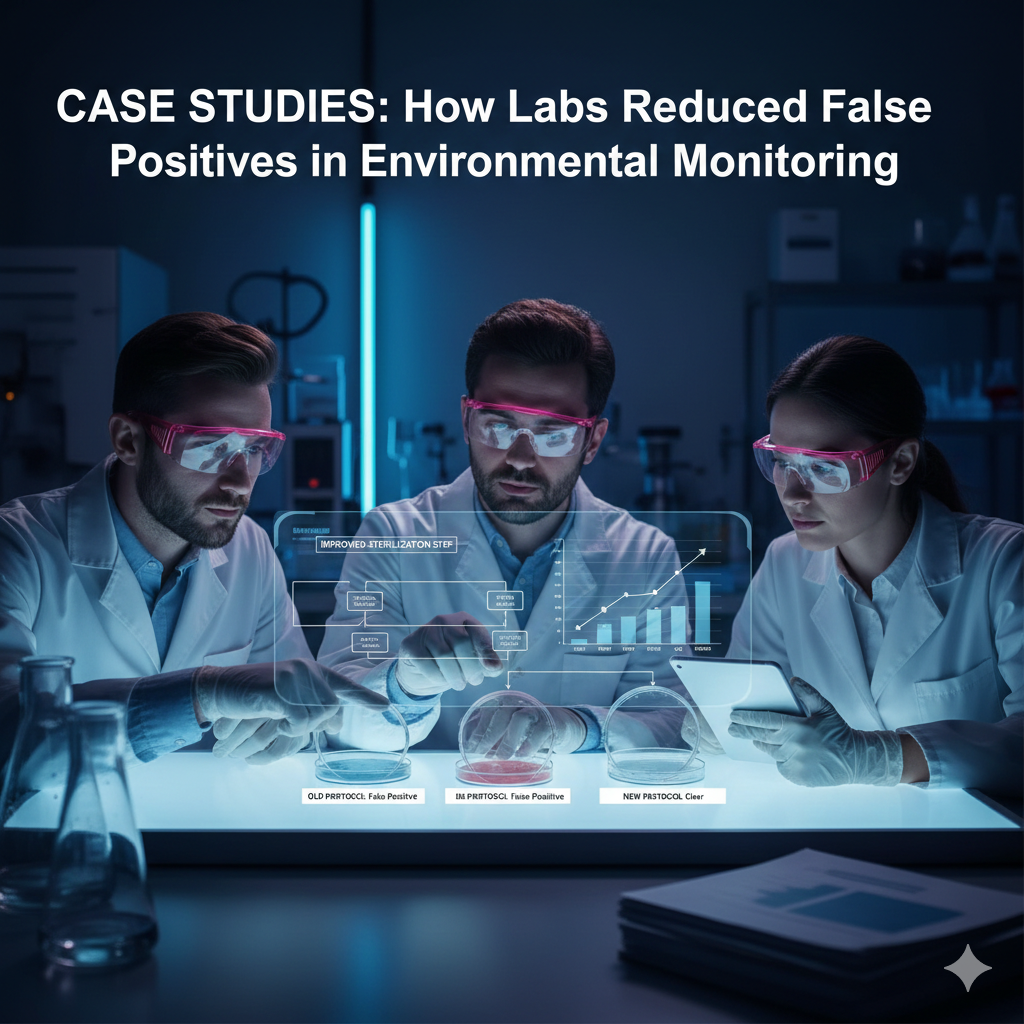
In Environmental Monitoring (EM), a “false positive” is more than just a nuisance—it’s an expensive nightmare. A single contaminated air plate in a Grade A zone can trigger a full batch hold, weeks of root-cause investigations, and thousands of dollars in lost productivity.
At MicTest.wiki, we analyzed three real-world scenarios where labs successfully identified and eliminated the sources of false positives. These cases highlight that the issue is rarely the product; it’s almost always the process.
Case Study 1: The “Glove-Tip” Contamination Mystery
The Setting: A mid-sized sterile injectable facility.
The Problem: The lab saw a 15% spike in Staphylococcus epidermidis (a common human skin bacterium) on settle plates inside their ISO 5 laminar flow hoods.
The Investigation: The facility used a “Traditional Plating” method. Since S. epidermidis is human-associated, the initial suspicion was a breach in gowning. However, the gowning logs showed no changes in personnel or protocols.
The team decided to perform a mic test on the analysts’ gloves before and after the sampling session. They discovered the contamination was only appearing after the settle plates were collected.
The Root Cause: Analysts were accidentally touching the agar surface while placing the lids back on the plates at the end of the shift.
The Solution: * Implemented lid-handling tools that prevented fingers from coming near the agar.
- Retrained staff on the “shadowing” principle (never passing a hand directly over an open plate).
The Result: False positives dropped by 92% within 30 days.
Case Study 2: The “Hiding” Spores in the Incubator
The Setting: A high-volume food testing laboratory.
The Problem: The lab consistently reported Bacillus species in their negative controls (blank plates). This suggested that the contamination was happening inside the lab, not at the production plant.
The Investigation: The team suspected the autoclave was failing. However, biological indicators proved the sterilization was successful. They then turned their attention to the incubation environment.
The Root Cause: The lab used a fan-forced incubator. Over time, fungal and bacterial spores had accumulated in the internal fan housing. Every time the door opened and the fan kicked on, it created a “dust storm” of spores that landed on the plates.
The Solution: * A deep-clean protocol using sporicidal agents was implemented for the incubator internals.
- Switched to Parafilm sealing for plates during incubation to prevent air exchange.
The Result: Negative control failures were eliminated entirely, saving the lab 10 hours of re-testing per week.
Case Study 3: The “Sanitizer Interference” False Negative
The Setting: A pharmaceutical cleanroom transitioning to a new disinfectant.
The Problem: This was a “reverse” false positive issue. The EM results were too clean—zero growth across the board for three months, which is statistically improbable for a facility of that size.
The Investigation: The QC team suspected that the new disinfectant (a quaternary ammonium compound) was leaving a residue on the surfaces. When they swabbed the surface, the residue was being picked up along with the microbes, killing them on the agar plate before they could grow.
The Root Cause: The mic test media (Tryptic Soy Agar) did not contain enough neutralizers to counteract the new disinfectant.
The Solution: * Reformulated the agar to include Lecithin and Polysorbate 80.
- Validated the “neutralization efficiency” according to USP <61>.
The Result: Realistic microbial counts returned, and the lab successfully identified a legitimate Micrococcus colony that the previous “over-sanitized” plates had missed.
Key Takeaways for Your Lab
| Issue Type | Common Source | Rapid Fix |
| Human-Associated | Poor “shadowing” or lid handling | Use forceps/tools for lid placement |
| Environmental | Incubator fans or HVAC vents | Periodic sporicidal deep-cleaning |
| Inhibitory | Disinfectant residue on swabs | Add neutralizers (Lecithin/Tween) to media |
Conclusion
Reducing false positives at MicTest.wiki isn’t about working harder; it’s about working smarter. As these case studies show, the most effective “mic test” is one that accounts for the human element and the chemistry of the environment.
Would you like me to help you design a “Contamination Source Tracking” sheet to help your lab identify patterns in your EM data?