Every microbiologist has faced the “Empty Plate Paradox”: a sample that looks suspicious under a microscope or causes a product to spoil, yet refuses to grow on standard agar. Traditional culture-based methods are limited by the “Great Plate Count Anomaly,” where only about 1% of microorganisms in any given environment are actually culturable in a lab setting.
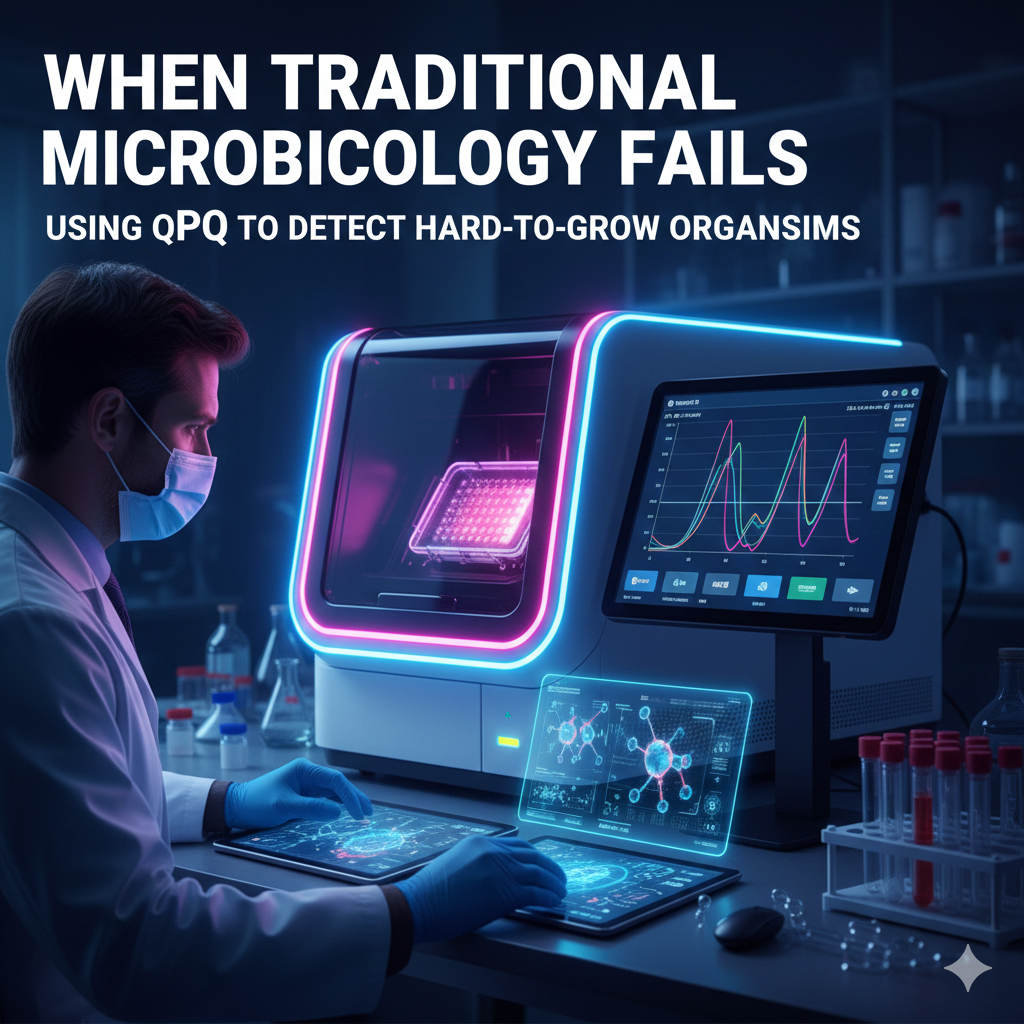
When your traditional mic test fails, Quantitative Polymerase Chain Reaction (qPCR) becomes your most powerful diagnostic ally.
The Limitation of the “Gold Standard”
Traditional plating relies on the organism being “happy” enough to reproduce. Hard-to-grow organisms, often called Fastidious Organisms, require hyper-specific nutrients, precise oxygen levels, or long incubation periods that make them nearly impossible to detect in a standard QC window.
Common culprits include:
- Legionella pneumophila (requires charcoal-buffered media).
- Campylobacter (requires microaerophilic conditions).
- Mycoplasma (lacks a cell wall and cannot be seen or grown on standard agar).
How qPCR Bridges the Gap
qPCR doesn’t care if a microbe is “happy” or even alive. It looks for the genetic blueprint—the DNA—of the target organism.
1. The Power of Amplification
By using specific primers, qPCR targets a unique segment of the organism’s genome. Through a series of temperature changes, the machine exponentially duplicates that DNA. Even if there is only a single cell in your sample, qPCR can amplify its signal to a detectable level.
2. Real-Time Quantification
Unlike traditional PCR, which only tells you if the DNA is present (Yes/No), Quantitative PCR uses fluorescent probes to measure the amount of DNA as it is being amplified. The sooner the fluorescence crosses the “threshold” (the $C_t$ value), the higher the initial microbial load in your sample.
Specific Scenarios: When to Choose qPCR
Scenario A: Detecting Mycoplasma in Cell Cultures
Mycoplasma is a nightmare for pharmaceutical labs. They are too small to see and don’t cause the cloudiness (turbidity) that other bacteria do.
- Traditional Fail: Culturing can take up to 28 days.
- qPCR Win: Results in under 4 hours, allowing for rapid intervention before an entire batch of expensive cell-based medicine is lost.
Scenario B: Environmental Monitoring for Legionella
Legionella thrives in cooling towers and water systems but is notoriously slow to grow on BCYE agar.
- Traditional Fail: 7–10 days for a result—by which time an outbreak may have already occurred.
- qPCR Win: Rapid screening identifies “hotspots” in a water system in real-time, allowing for immediate chlorination.
The Technical Challenges: What to Watch Out For
While qPCR is superior for speed, it requires a higher level of technical oversight than a simple plate count.
- DNA Extraction Efficiency: If you can’t break open the cell wall (lysis), you won’t get the DNA. Hard-to-lyse organisms like certain fungi require bead-beating or enzymatic digestion before the mic test begins.
- Inhibitors: Real-world samples (soil, chocolate, blood) contain chemicals that can “poison” the Taq polymerase enzyme. Always use an Internal Positive Control (IPC) to ensure that a “Negative” result is actually negative and not just a failed reaction.
- The Live/Dead Distinction: Since DNA can persist after a microbe has died, qPCR can sometimes overestimate the risk. To fix this, labs use Propidium Monoazide (PMA), a dye that binds to the DNA of dead cells and prevents it from being amplified, leaving only the “live” DNA for the test.
Conclusion
qPCR is not just a faster version of a plate count; it is a fundamentally different way of seeing the microbial world. For hard-to-grow organisms that bypass traditional defenses, molecular detection is the only way to ensure 100% confidence in your sterility and safety protocols.